Language development at age two is often a thrilling (and occasionally confusing) time for parents. One minute your toddler is saying “ball,” and the next they’re declaring “I do it myself!” with fierce independence. This is the age of discovery, mispronunciations that melt your heart, and first conversations that make you laugh and wonder all at once. But while every child grows at their own pace, understanding what to expect—and what to do if you’re concerned—can offer peace of mind.
What to Expect: Typical Language Milestones by Age 2
By their second birthday, most children will demonstrate many of these language skills:
Expressive Language (Speaking)
- Uses 50 to 100 words
- Begins combining two to three words (e.g., “want milk,” “go park”)
- Refers to themselves by name and starts using simple pronouns like “me” or “you”
- Asks basic questions like “What’s that?”
- Repeats words they hear in conversations
- Uses names of familiar people and objects correctly
- Begins to describe actions or wants (e.g., “Mommy sit,” “no want nap”)
Receptive Language (Understanding)
- Understands and follows simple directions (“Give me the toy”)
- Points to objects or pictures when named
- Recognizes names of familiar people and body parts
- Begins to understand location words like “in,” “on,” and “under”
- Can identify at least 5-10 common objects and body parts when asked
Keep in mind: If your child isn’t hitting all of these, don’t panic. Children develop language at different rates, and a quiet toddler today might be a chatterbox in three months. But there are also clear signs when additional support can help (more on that below).
The Two-Year Turning Point
This age marks the beginning of what’s often called the “language explosion.” Vocabulary increases rapidly, and toddlers begin to express themselves more clearly—sometimes even bossily! It’s an ideal time to reinforce strong communication habits and help them turn babble into beautiful conversation.
Do’s and Don’ts for Supporting Language Development
Do:
- Narrate your day: Talk about what you’re doing, seeing, and thinking.
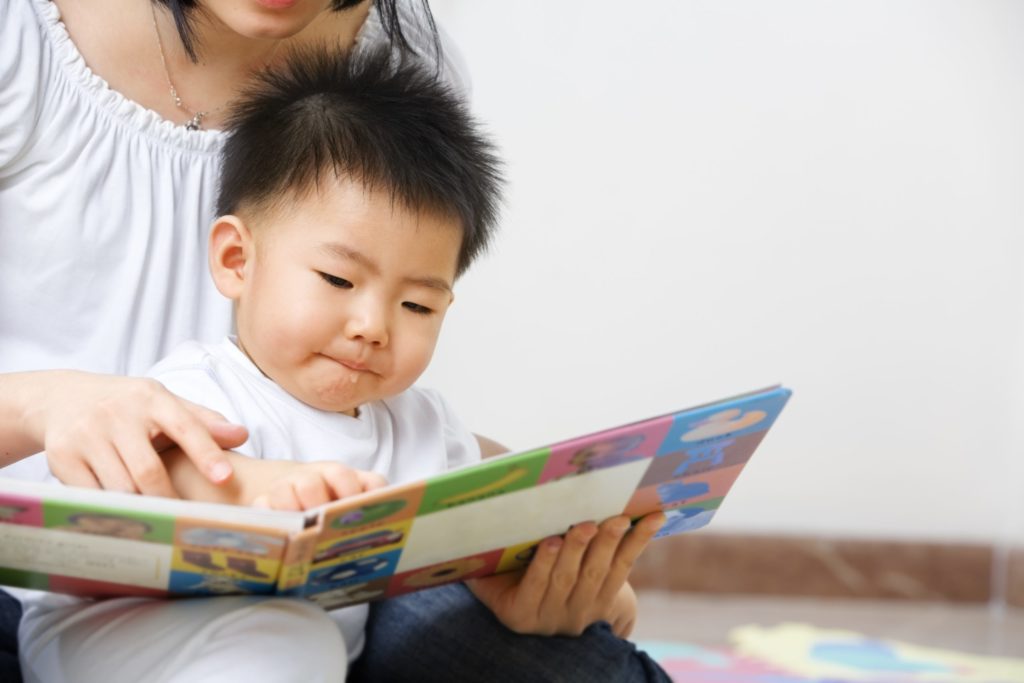
- Read every day: Choose interactive books with repetition and rhyming.
- Respond and expand: If your toddler says, “doggy bark,” you might reply, “Yes, the doggy is barking loudly because he sees a squirrel.”
- Ask open-ended questions: “What do you see?” instead of “Do you see the cat?”
- Use gestures and facial expressions: These reinforce the meaning of words.
- Celebrate efforts: Clap and cheer when your child tries new words—even if they sound funny.
Don’t:
- Don’t correct too much: If they say “goed,” gently model “You went,” rather than pointing out it’s wrong.
- Don’t rely on screens: Even educational videos can’t replace your voice and facial cues.
- Don’t rush: Silence gives them time to think and respond. Embrace the pause!
- Don’t compare: Every child learns at their own pace. Avoid comparisons to siblings or peers.
Strategies to Improve Language Acquisition
Research supports a few tried-and-true approaches:
- Responsive interaction: Let your child lead conversations. A 2009 Pediatrics study found that caregiver responsiveness is linked to better vocabulary development.
- Dialogic reading: Turn storytime into a back-and-forth experience. Ask questions, let them finish sentences, and discuss the story.
- Model rich language: Use a variety of words, even if they don’t use them yet.
What About Multilingual Households?
Raising a bilingual (or trilingual!) child doesn’t delay language—it enhances it. It’s normal for a multilingual toddler to mix languages or use fewer words in each one early on. Keep going!
What to Expect in Multilingual Development:
- Your child may have a combined vocabulary across both languages rather than a large vocabulary in each.
- Code-switching (mixing languages) is typical and not a cause for concern.
- They may prefer one language temporarily but can switch fluidly with regular exposure.
Bilingual Do’s and Don’ts
Do:
- Speak your strongest language: Use the language you’re most comfortable with for richer, more meaningful conversation.
- Provide exposure in each language: Through family members, books, songs, and community.
- Be consistent with routines: For example, one parent speaks Spanish and the other English, or Spanish is spoken at home and English outside.
- Use bilingual books: Read the same story in both languages to support understanding.
- Encourage both listening and speaking: Let your child answer in either language without pressure.
Don’t:
- Don’t worry about mixing languages: It’s part of the learning process.
- Don’t delay intervention if concerned: A speech delay in a bilingual child should still be evaluated—early help is helpful in any language.
Tips for Supporting Language in Multilingual Homes:
- Label objects in both languages at home.
- Play games that use words in each language.
- Share cultural stories and songs that highlight both languages.
- Find childcare providers or community programs that honor and support bilingualism.
Research by Paradis et al. (2010) shows that dual-language learners thrive with consistent exposure, emotional connection, and engaging conversations.
When to Seek Support
It’s okay to wonder, “Should they be talking more by now?” Seek guidance if your child:
- Says fewer than 50 words by age 2
- Doesn’t combine two words
- Doesn’t follow simple directions
- Loses previously used language or social interaction skills
Early help is effective and available. You’re not alone, and asking for support doesn’t mean something’s wrong—it means you’re proactive.
Video Resources:
English:
Spanish:
Local Resources for Westchester and Putnam Families
County-Based Programs
Westchester County Early Intervention Program
(914) 813-5094
https://health.westchestergov.com/early-intervention
Free evaluations and therapy for children under age 3.
Putnam County Early Intervention Services
(845) 808-1390
https://www.putnamcountyny.gov/health
Supports speech-language evaluations and therapy.
Pediatric and Family Services
Open Door Family Medical Centers
(914) 632-2737
https://www.opendoormedical.org
Pediatric visits include developmental screenings and parenting support.
Sun River Health (Peekskill)
(914) 734-8740
https://www.sunriver.org
Offers bilingual services and developmental assessments.
WJCS ParentChild+ Program
(914) 761-0600
https://www.wjcs.com
Home-based early learning program for language and literacy.
Family Services of Westchester
(914) 937-2320
https://www.fsw.org
Workshops and early literacy support.
Education and Literacy Support
Child Care Council of Westchester
(914) 761-3456
https://www.childcarewestchester.org
Referral support for programs that promote early learning and communication.
Westchester Library System
https://www.westchesterlibraries.org
Storytimes and toddler literacy events.
Putnam Valley Library – Little Learners
(845) 528-3242
https://www.putnamvalleylibrary.org
Interactive parent-child programs that promote speech and bonding.
Final Thoughts
At the end of the day, remember: your toddler’s voice is still warming up. Every “uh-oh,” every babbled phrase, every earnest attempt to say “truck” (or something that sounds wildly inappropriate instead) is progress. Be patient, stay engaged, and talk with your child as often as you can. Your words today build the conversations of tomorrow.
Language learning is not a race—it’s a relationship. And you’re doing a great job
Bibliography and Further Reading
- Paradis, J., Genesee, F., & Crago, M. (2010). Dual Language Development and Disorders: A Handbook on Bilingualism and Second Language Learning (2nd ed.). Paul H. Brookes Publishing.
- Zimmerman, F. J., Christakis, D. A., & Meltzoff, A. N. (2009). Associations between media viewing and language development in children under age 2 years. Pediatrics, 124(4), 766-771.
- Whitehurst, G. J., Falco, F. L., Lonigan, C. J., Fischel, J. E., DeBaryshe, B. D., Valdez-Menchaca, M. C., & Caulfield, M. (1994). Accelerating language development through picture book reading. Developmental Psychology, 30(5), 679–689.
- American Speech-Language-Hearing Association (ASHA). (2022). Speech and Language Developmental Milestones. Retrieved from https://www.asha.org
- Center on the Developing Child at Harvard University. (2016). From Best Practices to Breakthrough Impacts: A Science-Based Approach to Building a More Promising Future for Young Children and Families. Retrieved from https://developingchild.harvard.edu
Legal Disclaimer: The information provided by our nonprofit is for informational purposes only and not a substitute for professional medical advice, diagnosis, or treatment. Always consult a qualified healthcare provider for medical concerns. We make no guarantees about the accuracy or completeness of the information and are not liable for any decisions made based on it. If you have a medical emergency, call 911 or seek immediate medical care.