At age 3, your child is bursting with curiosity—asking questions, sorting their toys, and insisting they definitely know how to pour the juice by themselves. Believe it or not, these little everyday moments are laying the foundation for math success.
We’re not talking flashcards or memorization drills. We’re talking blocks, snacks, socks, and songs. That’s where pre-math happens for toddlers—and it’s way more powerful than you might think.
Let’s explore how your 3-year-old naturally builds math skills through play, and how you can support it without turning life into a math lesson.
What Are Pre-Math Skills?
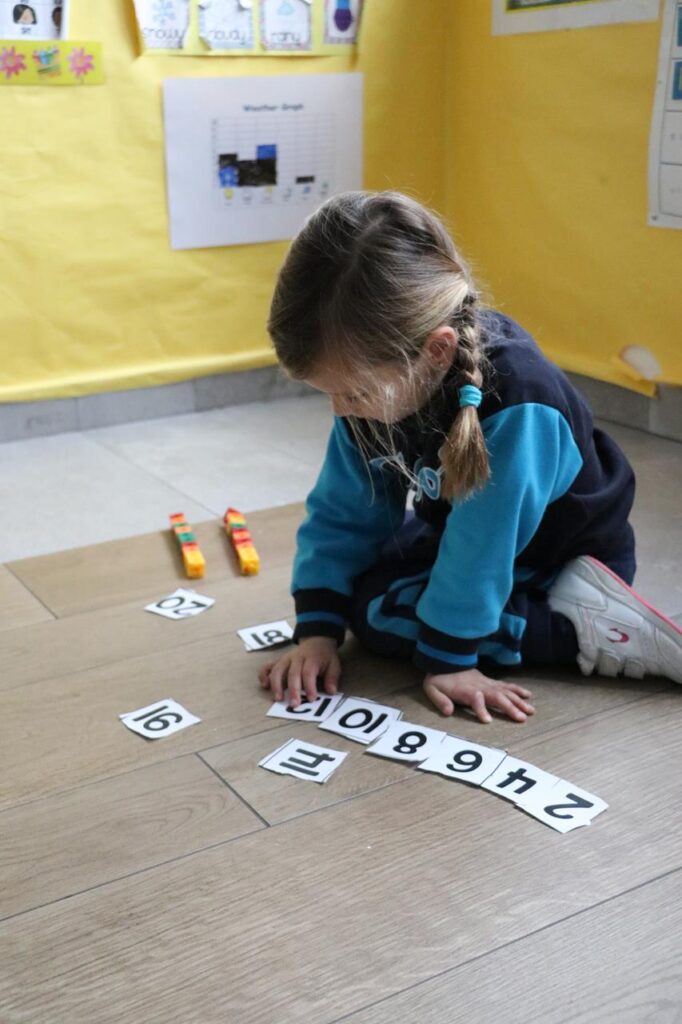
Pre-math skills are early understandings that help children make sense of the world and prepare for later math learning. At age 3, this includes:
- Counting and number sense – Understanding that numbers mean how many
- Sorting and classifying – Grouping objects by shape, color, or size
- Patterns – Recognizing simple sequences, like red-blue-red-blue
- Comparing – Noticing more vs. less, big vs. small
- Position and space – Learning words like “under,” “next to,” and “behind”
And the best way to build these? Play. Lots of it.
Everyday Play = Everyday Math
You don’t need special toys. You don’t need a degree in early childhood education. You just need to notice the math that’s already happening—and lean into it.
Here are some fun, natural ways to build math thinking during everyday play:
1. Play With Blocks or Stacking Cups
What they’re learning:
- Size comparison
- Spatial awareness
- Counting (“Let’s build a tower with 5 blocks!”)
Try saying:
“How many blocks can we stack before it falls?”
“Which cup is the smallest?”
2. Sing Songs With Numbers
Songs like “Five Little Monkeys” and “The Ants Go Marching” teach:
- Counting forward and backward
- Number recognition
- One-to-one correspondence (one word per object)
Try this:
Use your fingers to count while you sing.
Pause and ask, “What number comes next?”
3. Sort Toys or Snacks
Sorting is a key early math skill. Kids can sort by color, shape, size, or type.
Try this:
“Let’s find all the blue cars!”
“Can you sort your crackers into two piles—round and square?”
4. Compare During Snack Time
Snack time is math time in disguise.
Try this:
“Do you want a big apple slice or a small one?”
“I have two grapes, and you have three—who has more?”
5. Use Math Words in Your Day
Math is in your language. Use it naturally throughout the day.
Try these words:
More, fewer, same, big, small, long, short, empty, full, heavy, light, under, over, behind
Try this:
“Let’s put the teddy bear under the blanket.”
“This bag of toys is heavier than your book.”
Dos and Don’ts for Building Pre-Math Skills
| Do | Don’t |
|---|---|
| Talk about numbers, size, and patterns during play | Don’t push flashcards or memorization at this age |
| Celebrate effort and curiosity | Don’t correct every mistake—exploration is how they learn |
| Let them guess or estimate (“How many blocks do you think we need?”) | Don’t expect perfection—“wrong” answers are part of learning |
| Follow their lead—join their play and add just a little math | Don’t force activities if your child is frustrated or uninterested |
Encouragement for Parents
You’re already doing the most important thing: being there and playing. When your 3-year-old lines up dinosaurs, hands you two crackers, or says “This tower is BIG,” they’re not just being cute—they’re being mathematicians.
Remember, math at this age isn’t about worksheets. It’s about thinking, noticing, comparing, and trying again. So lean into the mess, the giggles, and the snack math. You’re helping your child build a strong foundation just by showing up.
Local Resources for Families in Westchester County
1. Child Care Council of Westchester
Offers referrals to high-quality early childhood programs, parenting workshops, and resources on early math and literacy development.
Website: www.childcarewestchester.org
Phone: (914) 761-3456
2. Westchester Library System – Early Literacy & STEM Programs
Many local branches offer story times and math-based play programs like “Math & Movement” or STEM playgroups for toddlers and preschoolers.
Website: www.westchesterlibraries.org
Phone: (914) 231-3200
4. Ossining Children’s Center (Westchester)
Provides early childhood education, including play-based math skill development.
Website: www.ossiningchildrenscenter.org
5. YMCA of Central and Northern Westchester
Hosts early childhood enrichment programs with hands-on learning in math and science.
Website: www.ymca-cnw.org
6. Mount Kisco Child Care Center
Features the JEWEL Program (Joining Eating Well with Education and Learning) that blends meals with learning experiences—great for practicing counting, measuring, and sequencing.
Website: www.mkccc.org
Video Resources:
English:
Spanish:
Bibliography & Research Sources
- Center for Early Childhood Education (CECE) – Eastern Connecticut State University.
Math in the Early Years: A Strong Predictor for Later Academic Success.
https://www.easternct.edu/center-for-early-childhood-education - National Association for the Education of Young Children (NAEYC).
The Power of Play-Based Learning in Building Math Skills.
https://www.naeyc.org/resources/topics/math - ZERO TO THREE.
Tips on Helping Toddlers and Preschoolers Develop Early Math Skills.
https://www.zerotothree.org - PBS KIDS for Parents.
Math Activities for Toddlers and Preschoolers.
https://www.pbs.org/parents/learn-grow/age-3/math - American Academy of Pediatrics (AAP).
Promoting Cognitive and Mathematical Development in Young Children.
https://www.healthychildren.org - Development and Research in Early Math Education (DREME Network) – Stanford University.
Math at Home: Everyday Activities that Support Children’s Math Learning.
https://dreme.stanford.edu - Harvard University – Center on the Developing Child.
Executive Function and Early Numeracy: How Children Think and Learn Math Through Play.
https://developingchild.harvard.edu
Legal Disclaimer: The information provided by our nonprofit is for informational purposes only and not a substitute for professional medical advice, diagnosis, or treatment. Always consult a qualified healthcare provider for medical concerns. We make no guarantees about the accuracy or completeness of the information and are not liable for any decisions made based on it. If you have a medical emergency, call 911 or seek immediate medical care.