urn Everyday Objects into Big Learning Adventures
Children don’t need expensive robotics kits or the latest technology to become scientists, engineers, and inventors. In fact, some of the most meaningful STEM (Science, Technology, Engineering, and Mathematics) learning happens using items you already have around your home.
At around six years old, children’s brains are developing rapidly. They are naturally curious, constantly asking questions, making predictions, and experimenting with how the world works. Hands-on STEM activities encourage this curiosity while building confidence, creativity, problem-solving skills, and persistence.
The best part? No screens required.
Why Screen-Free STEM Matters
While educational apps can certainly have their place, research consistently shows that young children learn best through active, hands-on experiences.
When children physically manipulate objects, they strengthen multiple areas of the brain simultaneously. They are using:
- Fine motor skills
- Visual-spatial reasoning
- Working memory
- Executive functioning
- Language development
- Critical thinking
- Creativity
According to research from the National Association for the Education of Young Children (NAEYC), young children develop deeper understanding when they actively explore materials rather than simply watching someone else demonstrate them.
Studies from the National Science Foundation also suggest that early exposure to STEM activities helps build confidence in science and math that can continue throughout elementary school and beyond.
What STEM Skills Does Your Child Practice?
Even simple household activities teach valuable lifelong skills.
Scientific Thinking
Children learn to:
- Observe
- Ask questions
- Make predictions
- Test ideas
- Notice patterns
- Draw conclusions
Engineering Skills
Engineering is simply solving problems.
Children begin asking:
- How can I build this stronger?
- Why did it fall?
- How can I make it go farther?
- What happens if I change one thing?
These questions are exactly how engineers think every day.
Math Skills
STEM naturally introduces:
- Counting
- Measuring
- Comparing sizes
- Shapes
- Patterns
- Estimating
- Sorting
- Basic geometry
Executive Function Skills
Many STEM activities strengthen the brain’s “air traffic control system,” including:
- Planning
- Organization
- Flexible thinking
- Self-control
- Working memory
- Persistence after mistakes
These skills are powerful predictors of later academic success.
10 Screen-Free STEM Activities Using Household Items
1. Build the Tallest Tower
Materials
- Toilet paper rolls
- Paper cups
- Books
- Playing cards
- Blocks
- Empty cereal boxes
Challenge your child to build the tallest tower possible.
Ask:
- What makes it stronger?
- What happens if we use heavier objects?
- How can we stop it from falling?
Learning:
- Balance
- Gravity
- Engineering
- Problem solving
2. Sink or Float Experiment
Materials
- Large bowl
- Water
- Spoon
- Toy car
- Cork
- Apple
- Coin
- Sponge
- Plastic lid
Before placing each object into the water, have your child predict whether it will sink or float.
Create two piles afterward:
- Sink
- Float
Discuss why each object behaved the way it did.
Learning:
- Scientific observation
- Predictions
- Density
- Classification
3. Homemade Marble Maze
Materials
- Cardboard box
- Toilet paper tubes
- Tape
- Marble or small ball
Tape the tubes inside a box and create a maze.
Challenge your child to redesign the maze after every attempt.
Learning:
- Gravity
- Engineering design
- Cause and effect
- Trial and error
4. Rainbow Walking Water
Materials
- Clear cups
- Water
- Food coloring
- Paper towels
Fill alternating cups with colored water.
Connect cups using folded paper towels.
Watch as the water “walks” into empty cups.
Discuss:
- Where is the water going?
- Why does it move?
Learning:
- Capillary action
- Observation
- Color mixing
5. Paper Airplane Challenge
Instead of making just one airplane, become airplane engineers.
Experiment by changing:
- Wing size
- Nose shape
- Paper type
- Throwing angle
Measure:
- Which flew farthest?
- Which stayed in the air longest?
Learning:
- Aerodynamics
- Measurement
- Engineering
6. Build a Bridge
Materials
- Popsicle sticks
- Index cards
- Tape
- Books
Can your bridge hold:
- Five pennies?
- Twenty pennies?
- One toy car?
Encourage redesign after each test.
Learning:
- Structural engineering
- Weight distribution
- Persistence
7. Kitchen Measuring Lab
While baking or cooking together, invite your child to help measure ingredients.
Discuss:
- Fractions
- Full vs. half
- More vs. less
- Estimating
Cooking naturally combines math, science, and reading.
8. Balloon Rocket
Materials
- Balloon
- Straw
- String
- Tape
Thread string through a straw.
Tape the balloon to the straw.
Release the balloon.
Ask:
- What pushed the balloon forward?
- What happens with a bigger balloon?
Learning:
- Force
- Motion
- Newton’s Third Law
9. Nature Engineering Hunt
Go outside and collect:
- Leaves
- Rocks
- Sticks
- Pinecones
- Flowers
Sort them by:
- Size
- Color
- Shape
- Texture
Then challenge your child to build something using only natural materials.
Learning:
- Classification
- Observation
- Creativity
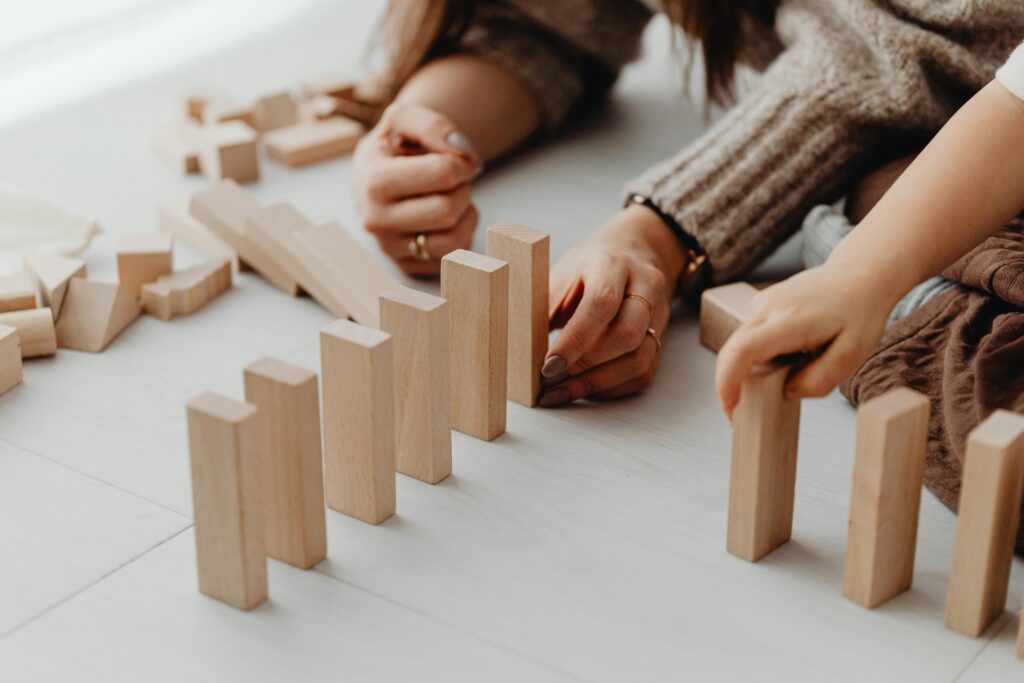
10. LEGO or Block Challenge Cards
Create challenges such as:
- Build a zoo.
- Build the tallest house.
- Build something that rolls.
- Build a bridge.
- Build a spaceship.
Afterward ask:
- What worked?
- What would you change?
This reflection develops engineering thinking.
The Power of Asking Questions
Parents don’t need to know all the answers.
In fact, asking questions is often even more valuable.
Try asking:
- What do you notice?
- Why do you think that happened?
- What might happen next?
- How could we make it stronger?
- What would you change?
- Can you think of another solution?
- What surprised you?
- How did you solve that problem?
Open-ended questions encourage children to think deeply rather than simply searching for the “right” answer.
Mistakes Are Part of STEM
Many adults try to prevent children from becoming frustrated.
But frustration is actually an important part of learning.
Every failed tower…
Every collapsed bridge…
Every airplane that dives into the floor…
…gives children new information.
Scientists call this the engineering design process:
- Ask a question.
- Imagine a solution.
- Build.
- Test.
- Improve.
- Try again.
This cycle teaches resilience, adaptability, and confidence.
Bringing STEM into Everyday Life
You don’t need to schedule special lessons.
STEM naturally appears during everyday routines:
- Grocery shopping becomes a math lesson by comparing prices and counting items.
- Laundry becomes a sorting activity by color, size, or fabric type.
- Gardening introduces biology, weather, and observation.
- Cleaning explores chemistry and cause-and-effect.
- Building forts teaches engineering and design.
Children begin seeing science and math everywhere.
Final Thoughts
The greatest gift parents can give is not all the answers—it’s the opportunity to explore.
By turning cardboard boxes, cups, paper towels, balloons, and kitchen supplies into learning adventures, you’re helping your child develop curiosity, confidence, creativity, and perseverance. These experiences build the foundation for lifelong learning while creating meaningful family memories along the way.
Remember, the goal isn’t to create a future scientist or engineer overnight. It’s to raise a child who isn’t afraid to ask, “What if?”—and who feels excited to discover the answer.
Video Resources:
English:
Spanish:
Community Resources
Westchester Library System
Free STEM books, educational kits, maker programs, and children’s activities available through local public libraries.
Website: https://www.westchesterlibraries.org
Westchester Children’s Museum
Hands-on STEM exhibits, science workshops, and family learning events.
Website: https://discoverwcm.org
Hudson River Museum
Family STEAM workshops, planetarium shows, and interactive science programming.
Website: https://www.hrm.org
Greenburgh Nature Center
Nature-based science education, animal encounters, and environmental STEM activities for children.
Website: https://greenburghnaturecenter.org
The STEM Alliance
Offers STEM enrichment opportunities, robotics, coding, engineering programs, and family events throughout the Hudson Valley.
Website: https://www.stemalliance.org
PBS Parents
Free STEM activities, printable experiments, and educational resources for families.
Website: https://www.pbs.org/parents
Sesame Workshop
Hands-on learning activities and playful science exploration for young children.
Website: https://sesameworkshop.org
211 Hudson Valley
Families can connect with local educational programs, after-school opportunities, summer camps, and community resources by dialing 2-1-1 or visiting https://www.hudson211.org.
References
National Association for the Education of Young Children. (2022). Developmentally Appropriate Practice Position Statement.
National Science Foundation. (2024). STEM Education Research.
Harvard University Center on the Developing Child. Executive Function & Self-Regulation.
National Academies of Sciences, Engineering, and Medicine. (2022). Science and Engineering in Early Childhood.
American Academy of Pediatrics. (2020). Media and Young Minds.
Piaget, J. The Origins of Intelligence in Children.
Vygotsky, L. Mind in Society: The Development of Higher Psychological Processes.
Legal Disclaimer: The information provided by our nonprofit is for informational purposes only and not a substitute for professional medical advice, diagnosis, or treatment. Always consult a qualified healthcare provider for medical concerns. We make no guarantees about the accuracy or completeness of the information and are not liable for any decisions made based on it. If you have a medical emergency, call 911 or seek immediate medical care.